
REVIEW · ITALY
Discover Marvellous Rome: Self-Guided Audio Tour
Rome’s best stories often appear one street at a time, and this self-guided walk links fountains, temples, churches, political drama, and ancient ruins in one easy route. You’ll hear about emperors, popes, architects, and one of history’s most famous assassinations while moving from Trevi Fountain toward the Colosseum.
I like the freedom to set your own pace and the low price of $16.56, especially for a family that wants information without paying for a private guide. I also like the lively, humorous tone of the narration, which adds personality to the facts.
The trade-off is simple: you must download everything before you begin, carry your own phone and headphones, and manage the route yourself. Admission fees, food, drinks, transportation, and a physical guide are not included.
Key points at a glance
- Seven major Rome stops: The route covers Trevi Fountain, the Pantheon, Piazza Navona, Largo Argentina, the Church of Gesù, Campidoglio, and the Roman Forum.
- A flexible two-hour walk: The audio takes about two hours, but you can pause for coffee, food, shopping, or extra sightseeing.
- GPS map and audio files included: You use your own phone and headphones, so prepare the files before reaching Trevi Fountain.
- History with a lively tone: The narration combines useful facts with humor and stories about emperors, popes, kings, architects, sacred rites, and political violence.
- English and Dutch available: Choose from two language options when preparing the tour.
- Good value for independent visitors: At $16.56 per person, it costs far less than many private guided walks, but you give up live questions and on-the-spot help.
Why this Rome audio walk works
This experience is built for people who like to walk, pause, look around, and continue when ready. You are not tied to a group moving at someone else’s speed. If the Pantheon captures your attention or a café calls your name near Piazza Navona, you can stop the recording and pick it up again.
The route takes about two hours in its basic form, though the stated duration ranges from one to three hours. That difference makes sense for Rome. You may listen quickly and keep moving, or linger at each site and add breaks. The audio itself is the backbone of the outing, not a timed parade from one monument to the next.
The route begins at Trevi Fountain and finishes at the Colosseum area, though you decide how closely to follow those start and end points. The supplied meeting details list a 9:00 am start, while the tour also allows you to choose your own schedule. Check the download instructions on your ticket before setting out so you know exactly how the timing and route work for your booking.
The main practical task is preparation. Download the audio files and GPS map before you begin, then make sure they are ready on your phone. There is no physical audio device and no guide waiting at the fountain. Bring headphones, a charged phone, and shoes suited to a moderate amount of walking on city streets.
More self-guided film routes in Rome:
- Self Guided Audio Tour-Coliseum & the Gladiator’s Legends
★ 3.5 · 49 reviews - London: Self-Guided Notting Hill Walking Tour with an APP
★ 4.3 · 120 reviews - Romans, Vikings and Medieval York: An Audio Tour
★ 4.5 · 118 reviews
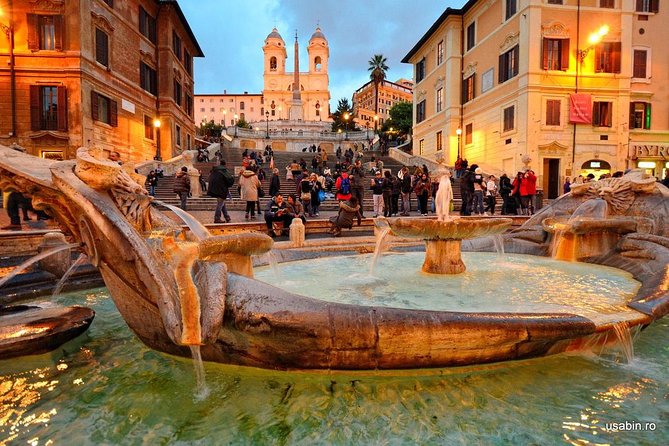
Trevi Fountain: begin with Baroque drama
Trevi Fountain is a fitting place to start. It is Rome’s largest and most famous Baroque fountain, a grand piece of theater built into the city rather than tucked away inside a museum. The audio introduces the fountain as your first major landmark and sets the tone for a walk filled with art, power, faith, and spectacle.
You are given about 15 minutes here, which is enough for a quick look and some orientation. In practice, you may want more time because the fountain is a natural pause point. The audio can be stopped while you examine the sculpture, find your bearings, or simply take in the scale of the setting.
No admission ticket is included, and the fountain is listed as an exterior stop rather than a ticketed attraction. That keeps the price low, but it also means the experience depends on your own close look at the site and the narration in your ears.
The Pantheon: two thousand years of change
From Trevi Fountain, the route continues to the Pantheon, one of Rome’s clearest reminders that the city has been rebuilt and reused across the centuries. A version of the building has occupied this site for more than 2,000 years.
The first Pantheon was built in 27 BC by Marcus Agrippa, who also built the Aqua Virgo aqueduct. That connection gives the audio a useful thread: Roman monuments were not isolated projects, but part of a wider system of engineering, public life, religion, and political ambition.
The stop is allotted 15 minutes. You can use that time to listen, study the building, and decide if you want a longer visit. Admission is not included, so any interior entry must be handled separately. That matters because the audio walk gives you context, but it does not function as an admission ticket or replace a full visit inside.
I like this stop because the story is easy to grasp even if you know little about Roman history. You can look at the building in front of you while the narration explains why this spot has mattered for so long.
Piazza Navona: an arena turned public square
Piazza Navona brings you into one of central Rome’s most memorable open spaces. The square occupies the site of the ancient Circus Agonalis, a competition arena built by Emperor Domitian in the first century AD for sporting events and chariot races.
The old arena was even larger than the Colosseum. The name is also part of the story. Agonalis is believed to have changed over time into N’agona and eventually into the present name, Navona.
The audio allows about 15 minutes here. That is enough for the historical explanation, but the square is worth treating as a place to pause rather than a point to tick off. You can stop the recording and take time with the architecture, street life, and surrounding cafés.
Because the tour is self-guided, the route does not force you to move on when the narration ends. That is one of its best features. A live guide might need to keep the group together. You can stay put, order something, shop nearby, or resume the walk when ready.
More audio location walks in Rome:
- Turin: National Museum of Cinema Entry Ticket & Audio Guide
★ 3.6 · 70 reviews - Harry Potter’s Edinburgh: A Self-Guided Audio Tour
★ 4.5 · 42 reviews - Hollywood Fame & Celebrity Homes Self-Guided Audio Bundle Tour
★ 3.5 · 40 reviews - Marvellous Melbourne: A Self-Guided Audio Tour
★ 4.5 · 26 reviews
Largo Argentina: ruins and a famous assassination
Area Sacra di Largo Argentina gives the route a darker edge. The site contains the remains of four ancient temples, but it is also linked to one of history’s most notorious political assassinations.
That combination makes this a strong audio stop. The ruins may not explain themselves at first glance. The narration supplies the human drama and historical setting that help you understand why this otherwise open archaeological area matters.
You are given about 15 minutes. Listen carefully here, because the appeal is less about one complete monument and more about connecting fragments of stone with the events that took place around them. The tour does not include an admission fee, and no ticket is listed for the stop.
This is also a good example of why an audio walk can work well in Rome. You do not need a guide standing beside you to tell the story, but you do need clear narration to turn scattered ruins into a meaningful stop. The supplied audio is described as informative and humorous, with a narrator who brings energy to the material.
Church of Gesù: a change from ruins to grand faith
The Church of the Most Holy Name of Jesus is usually called Gesù. Its full name is less important than what the stop does for the route: it shifts you from ancient temples and republican politics into the world of Catholic Rome.
You are still following the same city, but the mood changes. Rome’s story is not only about emperors and ruins. It is also about religious power, sacred rites, architecture, and the popes and church leaders who shaped the city.
The visit is planned for about 15 minutes, and admission is not included. Treat the audio as an introduction rather than a complete church tour. If you want to go inside, check the current entry arrangements separately and allow extra time beyond the basic recording.
I like the contrast here. After Largo Argentina, the church helps you see how Rome’s layers sit almost on top of one another. A short walk can carry you from ancient ritual to Christian ceremony and from broken temples to a highly finished religious interior.
Campidoglio: Michelangelo and the Capitoline Hill
Piazza del Campidoglio is one of the route’s most important architectural stops. The trapezoidal plaza was designed by Michelangelo in the mid-1500s, yet the hill itself reaches back to Ancient Rome.
That layering is the point. The square is not simply a Renaissance design exercise. It occupies a place with political and religious importance long before Michelangelo reshaped it. The audio connects the visible plaza with the older history beneath and around it.
Again, the suggested listening time is 15 minutes. You can pause to study the geometry of the square and then continue toward the Roman Forum. Since no physical guide accompanies you, the map and GPS directions matter here. Keep an eye on your phone, especially when moving between historic sites and modern streets.
The route’s pattern is now clear: one stop gives you a monument, the next gives you a story, and the connection between them comes from walking. You are not confined to a coach or a fixed indoor schedule. You are moving through Rome as a city people still use.
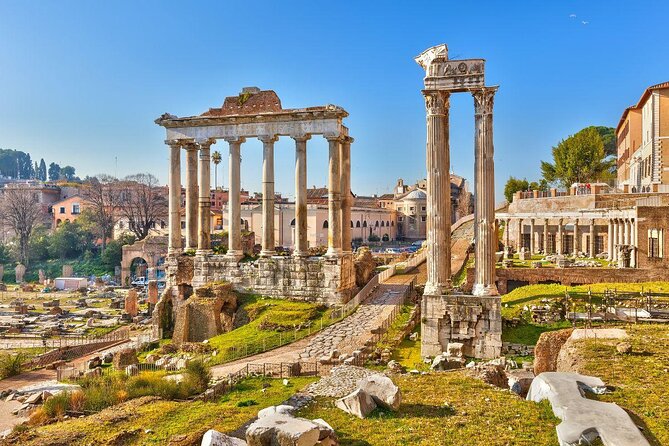
Roman Forum: finish among the ruins
The Roman Forum occupies the valley between Capitoline Hill and Velian Hill. The area began as a deserted marshland before becoming one of the central places of Roman public life.
This is a strong final stop because earlier sections of the walk have prepared you to read the ruins. The stories of emperors, political power, sacred ceremonies, and public events come together here. The setting is fragmented, but the audio helps you imagine the importance of the area when it was active.
The listed listening time is about 15 minutes, though you may want to linger. Admission to the Forum is not included, so the tour does not give you entry to the archaeological site. The stated endpoint is the Colosseum at Piazza del Colosseo, but the provided details do not promise a Colosseum admission ticket or a separate Colosseum interior tour.
That distinction is important. You are buying a self-guided audio route through Rome, not a package of monument entries. If you want to go inside the Forum or Colosseum, plan and pay for those visits separately.
What $16.56 gets you
At $16.56 per person, this is priced as a low-cost introduction to central Rome. The value is strongest if you want an organized route and historical context but do not need a guide beside you.
A private guide offers conversation, immediate answers, and help with navigation. This audio tour offers something different: control. You can pause, backtrack, stop for lunch, or split the route into shorter sections without holding up anyone else.
The cost also works well for families. One piece of feedback specifically found it a cheaper option than hiring a guide for a family and felt the information justified the price. That is a useful way to judge the experience. You are not paying for personal attention, but you are paying a small amount to give your walk shape and meaning.
The main value comes from the narration. It covers the city’s emperors, architects, popes, and kings, along with political assassinations, ancient mysteries, sacred rites, and modern splendor. The other strong point is tone. The guide is described as funny and highly engaged with the subject, which helps prevent the walk from feeling like a list of dates.
The practical side of a self-guided walk
You should prepare before reaching Trevi Fountain. Download the audio files, open the GPS map, and make sure the recording is ready to play. The provider does not supply an audio device, so your phone and headphones are essential.
The tour is available in English and Dutch. There is no named live guide because this is a recorded experience. That makes language selection simple, but it also means you cannot ask for a slower explanation or a different focus during the walk.
The route requires a moderate level of physical fitness. Exact distances and street conditions are not provided, so plan for ordinary city walking and allow time to pause. The route is near public transportation, which can help you reach the start or leave the area at the end, but transportation itself is not included.
Service animals are allowed. Confirmation arrives at booking, and the activity has a maximum of 10 participants, though the self-guided format means you are not following a conventional group with a live leader.
You can cancel for a full refund if you do so at least 24 hours before the local start time. Changes or cancellations made later are not accepted for a refund.
Who should choose this tour
I would choose this walk if I wanted a first look at central Rome with a little structure and plenty of independence. It suits solo visitors, couples, and families who want to spend less than they would on a private guide.
It is also useful for people who enjoy stopping often. Pause for food near Piazza Navona, take extra time at the Pantheon, or turn the route into a morning walk instead of rushing through it in two hours.
You should think twice if you want a live expert, detailed interior tours, or help handling admission lines. None of those are included. You also need to be comfortable with your phone, GPS directions, and downloading files before you start.
Should you book this Rome audio tour?
Book it if you want an affordable, flexible introduction to Rome’s central sights and are happy to guide yourself. The strongest reasons are the route, the useful historical coverage, and the lively narration, which gives the walk more character than a silent map.
Skip it if your priority is a fully guided experience with included admission, personal questions, or detailed time inside the Pantheon, Roman Forum, or Colosseum. For everyone else, $16.56 buys a practical walking framework and enough background to help Rome’s famous stones make sense.
FAQ
Where does the audio tour start?
The listed start point is Trevi Fountain at Piazza di Trevi, 00187 Rome, Italy. Because the tour is self-guided, you can choose your own starting point and schedule.
Where does the tour end?
The listed end point is the Colosseum at Piazza del Colosseo, 1, 00184 Rome, Italy. The tour does not include Colosseum admission.
How long does the tour take?
The audio walk takes about two hours. The stated duration is approximately one to three hours because you can pause the recording for food, shopping, or extra sightseeing.
What is included?
You receive downloadable audio files and a GPS map. The experience is self-paced.
Are admission fees included?
No. Admission fees are not included for the stops, and food, drinks, transportation, and an audio device are also excluded.
Which languages are available?
The audio tour is available in English and Dutch.
Do I need to prepare anything before starting?
Yes. Download the audio files and make them ready before you begin. You will need your own phone and headphones because no physical audio device or guide is provided.
Just added around Rome
- Colosseum Gladiator’s Arena and Ancient Rome Tour★ 4.5 · 7 reviews
- 3-Hour Colosseum Gladiator’s Arena and Ancient Rome Tour★ 4.5 · 8 reviews
- The Colosseum Arena & Gladiator Chronicles Private Tour★ 5.0 · 14 reviews
- Rome : Arena of Gladiators Tour with Forum Access★ 4.0 · 6 reviews
- From Colosseum Gladiators to Via Sacra: Rome’s Historic Heart★ 5.0 · 12 reviews
- Tour of Gladiators Arena and Colosseum with Imperial Forum★ 4.5 · 8 reviews
- Colosseum & Roman Forum with Gladiator Arena For Kids & Families★ 5.0 · 2 reviews
- Marvels Of Rome At Night – Private Tour★ 4.5 · 26 reviews
Italy Film Location Tours, compared.
Colosseum Tour with Access to the Gladiator Arena
Read our review →
Gladiator’s Gate: Special Access Colosseum Tour with Arena Floor
Read our review →
Colosseum Arena Floor, Roman Forum & Palatine Hill Tour
Read our review →
Roman Gladiator School: Learn How to Become a Gladiator
Read our review →
Full Day Tour to Val d’Orcia and Gladiator’s Fields with Wines
Read our review →
Gladiator’s Gate and Arena Special Colosseum Access
Read our review →
Browse the lists this tour appears in