
REVIEW · ITALY
From Colosseum Gladiators to Via Sacra: Rome’s Historic Heart
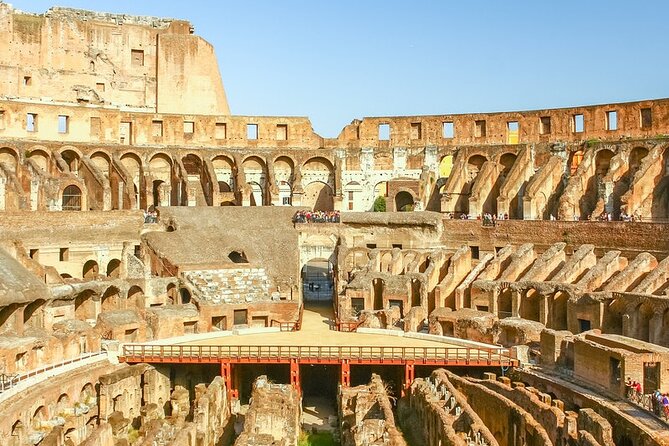
The best part of this tour is the Colosseum Arena floor, where gladiators once fought before packed crowds. You then move through Palatine Hill and the Roman Forum, following the route of triumphs, politics, and public life in ancient Rome. The guided format gives these broken stones a human story.
I like the sensible three-hour route and the included entry to all three major sites. I also like the smaller Arena access, which gives you a more unusual angle on the Colosseum than a basic exterior visit. The main concern is sound: one guest found the microphone hard to hear, and you should expect plenty of standing and walking.
Key points to know
- Arena access is the tour’s special feature: You go down to the floor where gladiatorial contests took place.
- The route covers three major ancient sites: Colosseum, Palatine Hill, and Roman Forum, with admission included.
- The Via Sacra adds useful context: Your guide explains processions, political speeches, daily life, and Roman legends.
- Groups can reach 25 people: This is a shared tour, not a private visit.
- Plan for physical effort: Expect about three hours of walking and standing, including the climb up Palatine Hill.
- Schedule changes are possible: If your selected time is unavailable, you may be moved to another departure on the same day.
Why the Colosseum Arena changes the visit
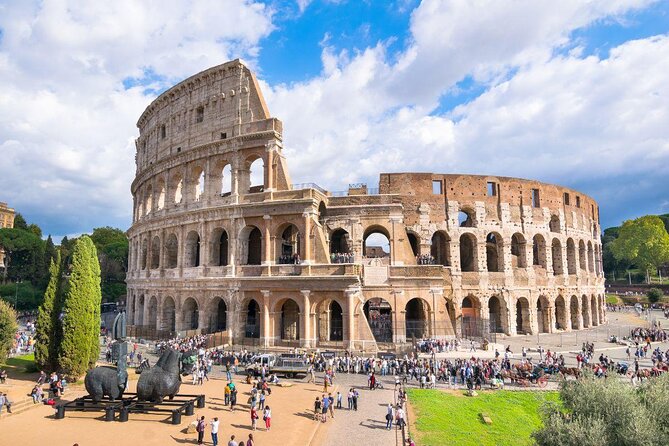
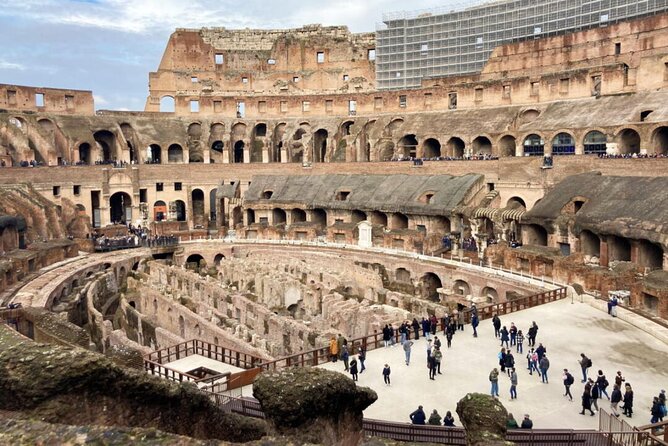
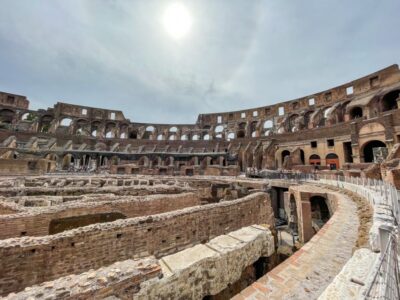
The Colosseum is easy to admire from outside. Its huge arches and weathered stone already tell you that Rome built on a scale few ancient cities could match. But the Arena floor gives you a more direct sense of the building’s purpose.
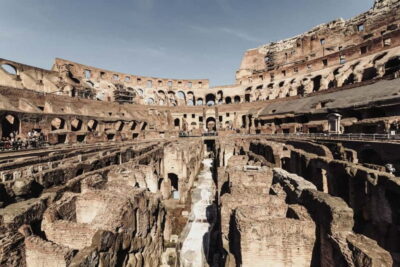
You go down to the level where gladiators fought. That matters because the Colosseum can otherwise feel like a grand shell viewed from above. On the Arena floor, the building becomes a working venue: fighters entered, crowds watched from rising seats, and public entertainment was organized around spectacle and power.
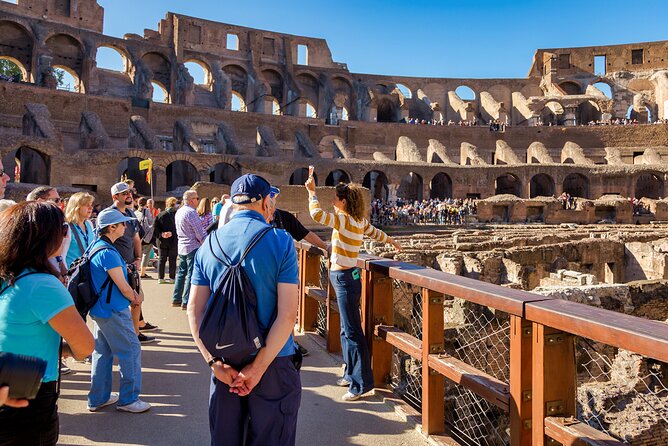
Access to this area is more limited than a standard visit to the amphitheater. The smaller number of people allowed onto the Arena floor can make this portion feel less crowded than the main viewing areas. It is not a private experience, but it gives your group a distinct place to hear the guide and look back at the curved walls.
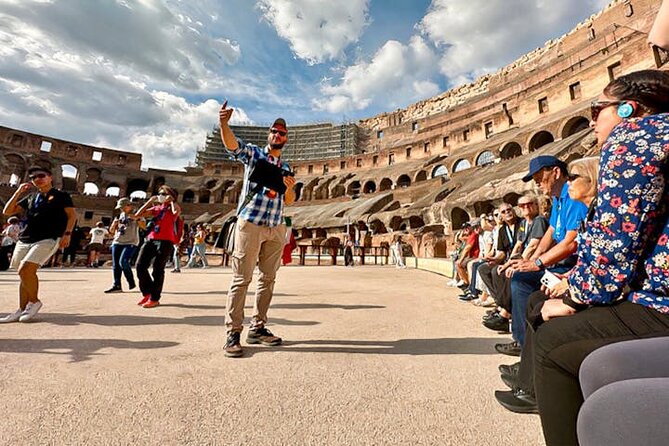
The Colosseum portion lasts about one hour. Your guide explains the contests, the building’s construction, and the way a day at the amphitheater was designed for public entertainment. The quality of this explanation matters. One particularly positive experience came with Sandra, who was described as thorough, clear, and attentive to everyone in her group.
Still, do not expect to spend the whole hour walking. Guided visits often pause at set places while the guide speaks, and one guest found the amount of stationary time tiring. Another had trouble hearing because of poor microphone pickup. Stay near the guide when possible and pay attention to the meeting instructions so you are not trying to follow from the back of a large group.
More history behind the scenes in Rome:
- Game of Thrones & History of Dubrovnik Tour
★ 5.0 · 628 reviews - History and Movie Tour of Beaufort by Golf Cart
★ 5.0 · 562 reviews - Memphis: Big Mojo Sun Studio + Music History 3-Hour Bus Tour
★ 4.8 · 325 reviews
From Constantine’s Arch to Palatine Hill
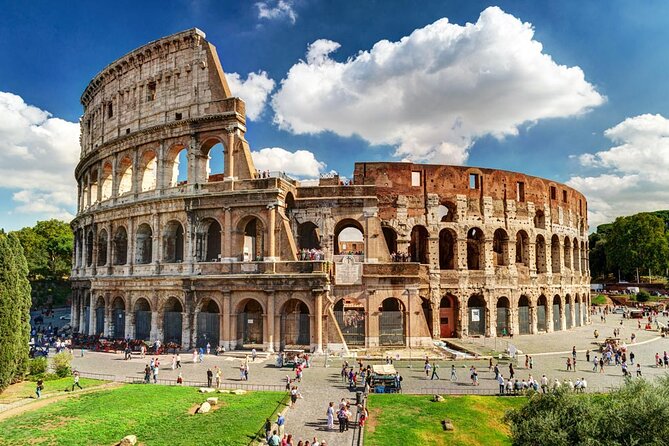
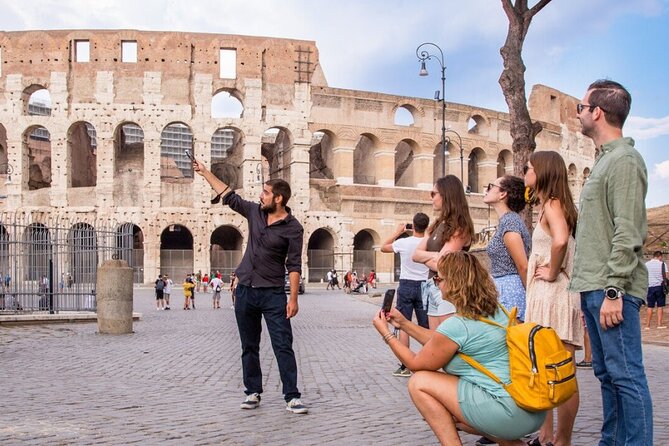
After the Colosseum, the route crosses the area near the Arch of Constantine. This is a useful transition between monuments because the arch is not simply a photo stop. Its reliefs and statues show how Roman art served political messaging and public celebration.
The arch was built as a triumphal monument, and its decoration helped present imperial power to everyone passing through this part of the city. Your guide uses the reliefs to explain Roman taste and the way rulers linked military victory with authority. For you, this adds a political layer to what might otherwise look like a collection of carved stone.
The route then reaches the Arch of Titus and begins the climb toward Palatine Hill. This is one of the more demanding sections of the tour. You should be ready for uneven ancient ground, slopes, and periods of standing while the guide explains the site.
Palatine Hill matters because it connects Rome’s mythic beginnings with its imperial past. It is one of Rome’s traditional seven hills and was treated as a prestigious place by the Romans. The tour focuses on the old sacred places tied to the stories of Rome’s foundation.
That combination is useful. You are not only looking at remains of elite residences and ancient structures. You are also hearing why Romans attached such importance to this hill. The foundation stories helped explain Rome’s identity, and the location later became associated with status and power.
The supplied route allows about one hour for Palatine Hill. That is enough time for a guided overview, but not enough for a slow, independent examination of every ruin. If you want to read every sign or stop often for photographs, you may feel pressed for time. The benefit is that the guide keeps the visit moving and connects the hill to the Colosseum and Forum instead of treating it as a separate pile of ruins.
Walking the Via Sacra through the Roman Forum
From Palatine Hill, you descend into the Roman Forum. This is where the tour’s historical storytelling becomes especially valuable. The Forum was the civic center of ancient Rome, and the Via Sacra ran through it as a road for processions and triumphs.
The stones are fragmented, and many buildings survive only as foundations or partial walls. Without context, it can be hard to tell which structure mattered and why. Your guide points out the Curia, where Roman senators met, along with the rostra, the platforms used for political speeches, and the area connected with the election of magistrates.
These details turn the Forum from a visual puzzle into a public center. You can picture political arguments, official ceremonies, religious processions, and everyday movement through the city. The route also includes the great triumphal arches, which help explain how Rome displayed military success in public spaces.
The guide also brings in stories about famous politicians, daily life, and ancient legends. That range is important. A good Forum visit needs more than dates and names. You want to understand how people used the space, how power was displayed, and how stories about Rome shaped the city’s view of itself.
The final section lasts about one hour. As with Palatine Hill, it includes walking and pauses for explanations. The ground is ancient and uneven, and the pace may feel tiring after the Colosseum and hill. Wear practical shoes and bring water, since food and drinks are not part of the tour.
What the three-hour pace means for you
Three hours is a reasonable amount of time for these sites, but this is not a relaxed stroll. You cover a lot of ground in a short half-day visit. The sequence also makes sense: Colosseum first, Palatine Hill next, then the Forum and Via Sacra below.
The order gives you a useful historical progression. You begin with mass entertainment, move to the hill associated with Rome’s origins and elite power, and finish in the civic center where politics and public ceremony took place.
You should expect a mix of walking, standing, listening, and looking. One positive account praised the guide for keeping the group interested despite the amount of effort. That is the key question here: can the guide make pauses feel worthwhile? Sandra received especially strong praise for clear explanations and attention to the full group, but guide assignments can vary.
The tour accepts groups of one to 24 people according to the booking information, with a stated maximum of 25 travelers. In practice, you should prepare for a shared group rather than an intimate private tour. A larger group can make it harder to hear, especially if the microphone is not working well, but it also keeps the price below what a private guide would cost.
Morning and afternoon departure times make the tour easier to fit into a Rome schedule. You should not, however, place another major activity immediately afterward. The provider advises against booking tours close together on the same day, and that is sensible given the walking, standing, and possible schedule changes.
Same place, a completely different screen:
- Rome: Colosseum Tour with Access to the Gladiator Arena
★ 4.4 · 7,046 reviews - Gladiator’s Gate: Special Access Colosseum Tour with Arena Floor
★ 4.5 · 4,037 reviews - Colosseum Arena Floor, Roman Forum & Palatine Hill Tour
★ 4.5 · 1,568 reviews - Roman Gladiator School: Learn How to Become a Gladiator
★ 4.5 · 1,477 reviews
Is $160.22 a fair price?
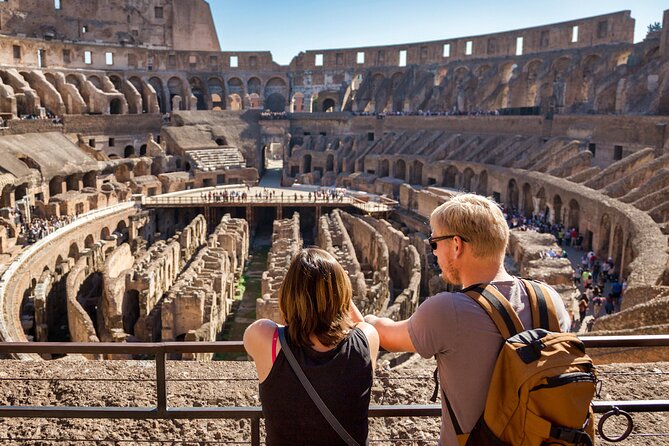
At $160.22 per person, this is not a bargain sightseeing walk. The value comes from combining three admission tickets with a live guide and Arena access in one organized visit.
You are paying for entry to the Colosseum, the Colosseum Arena, Palatine Hill, and the Roman Forum. You also avoid building the route and explanations yourself. For a first visit to ancient Rome, that can be worthwhile because the Forum and Palatine Hill are much easier to understand when someone identifies the Curia, rostra, arches, and ceremonial road as you go.
The price is harder to justify if you mainly want free time for photographs or prefer to explore ruins at your own pace. The shared format means you follow the guide’s schedule. You may also spend some time waiting while the group gathers or listening at fixed stops.
The Arena access strengthens the value. It is the feature that separates this experience from a basic walk around the outside of the Colosseum or a standard ticket visit. Since the access is included, you do not need to arrange separate tickets for the three main sites.
The overall rating is 4.8 from 12 ratings, with 92 percent recommending the experience. That is a positive signal, though the sample is small. I would put more weight on your own priorities: if clear guiding and access to the Arena matter most, the cost has a reasonable purpose. If you want flexibility, the price may feel high.
Practical details before you reserve
The meeting point is at Via di S. Giovanni in Laterano 14, 00184 Rome. The activity ends back at the meeting point. You arrange your own way there and back because hotel transportation is not included.
A mobile ticket is provided, and confirmation arrives at booking. You also need to provide a WhatsApp number so support can contact you after purchase. That is important because the selected departure time may change.
If your chosen slot is unavailable, you may be transferred to another time on the same day. The example given is a 9:00 a.m. selection moving to 10:00 a.m., noon, or 2:00 p.m. The provider warns that these changes can result from ticket counter availability, so do not schedule an important appointment right after your preferred start time.
Each person must bring a valid passport or identification document matching the name on the booking. This applies to entry at the Colosseum and Roman Forum. Children and students using the youth rate must also bring photo ID and proof of age.
Last-minute bookings carry extra risk. For a same-day or overnight booking, you may be moved to the following day if no seats remain. The experience is non-refundable and cannot be changed, so choose your date and time carefully before paying.
Most people can take part, and the tour is near public transportation. The information does not promise a private vehicle, hotel pickup, or a special accessibility arrangement. If stairs, slopes, prolonged standing, or uneven ground are a concern, contact the provider before booking.
Who will get the most from this tour?
I would recommend this experience to a first-time Rome visitor who wants the major ancient sites explained in one half-day. It works well if you want a clear route, included admission, and a guide who can connect physical remains with politics, legend, and ordinary public life.
It also suits you if the Colosseum Arena is a priority. That access gives the visit a stronger sense of place than simply seeing the amphitheater from the outer walkways.
Families and students may find the stories about gladiators, senators, triumphs, and Rome’s foundation easier to follow than a self-guided visit. The youth rate may help, but bring the required identification and age proof.
I would be more cautious if you dislike group tours, need a quiet pace, or want long stretches of independent exploration. The tour can also be frustrating if you are sensitive to poor audio. One guest found the guide’s microphone difficult to hear, so staying close to the guide is a useful practical step.
Should you book this Colosseum tour?
Book it if you want the Colosseum Arena, Palatine Hill, and Roman Forum covered in about three hours with a live guide. The route is well chosen, the entry tickets are included, and the Arena floor gives the experience a clear reason to cost more than a simple exterior visit.
Think twice if your main goal is flexibility. You may be moved to another start time, the group may include up to 25 people, and the non-refundable policy leaves little room for a change of plans.
My call: this is a good fit for a first ancient Rome visit, especially when you value explanation over wandering. Choose a time that leaves your schedule open, bring matching ID, wear shoes suited to uneven ground, and stay near the guide so you do not miss the story.
FAQ
How long does the tour last?
The tour lasts approximately three hours.
Which attractions are included?
The tour includes the Colosseum, Colosseum Arena, Palatine Hill, and Roman Forum.
Is admission included?
Yes. Entry to the Colosseum, Arena, Palatine Hill, and Roman Forum is included.
Is this a private tour?
No. It is a shared tour with groups of up to 25 people.
What is the meeting point?
The meeting point is Via di S. Giovanni in Laterano 14, 00184 Rome, Italy.
Where does the tour end?
The activity ends back at the meeting point.
Are hotel transfers included?
No. Round-trip hotel transfers are not included.
Do I need identification?
Yes. Each person must present a valid passport or identification document matching the booking name. Students and children using the youth rate need photo ID and proof of age.
Can the start time change?
Yes. If your selected time is unavailable, you may be moved to another available time on the same day.
Can I cancel or change the booking?
No. The experience is non-refundable and cannot be changed for any reason.
Just added around Rome
- Colosseum Gladiator’s Arena and Ancient Rome Tour★ 4.5 · 7 reviews
- 3-Hour Colosseum Gladiator’s Arena and Ancient Rome Tour★ 4.5 · 8 reviews
- The Colosseum Arena & Gladiator Chronicles Private Tour★ 5.0 · 14 reviews
- Rome : Arena of Gladiators Tour with Forum Access★ 4.0 · 6 reviews
- Tour of Gladiators Arena and Colosseum with Imperial Forum★ 4.5 · 8 reviews
- Colosseum & Roman Forum with Gladiator Arena For Kids & Families★ 5.0 · 2 reviews
- Marvels Of Rome At Night – Private Tour★ 4.5 · 26 reviews
- Colosseum Guided Tour with Special Access to the Gladiator Arena★ 4.0 · 7 reviews
Italy Film Location Tours, compared.
Colosseum Tour with Access to the Gladiator Arena
Read our review →
Gladiator’s Gate: Special Access Colosseum Tour with Arena Floor
Read our review →
Colosseum Arena Floor, Roman Forum & Palatine Hill Tour
Read our review →
Roman Gladiator School: Learn How to Become a Gladiator
Read our review →
Full Day Tour to Val d’Orcia and Gladiator’s Fields with Wines
Read our review →
Gladiator’s Gate and Arena Special Colosseum Access
Read our review →
Browse the lists this tour appears in