
REVIEW · BARCELONA
Barcelona in 2 Hours: Guided Walk Through History and Sights
Barcelona’s old center reveals its best stories on foot, and this two-hour route through the Gothic Quarter and El Born packs plenty into a short morning or afternoon. You’ll connect Picasso and Gaudí with Els 4 Gats, trace Catalan identity through plazas and memorials, and finish at the beautiful Santa Maria del Mar.
I like the route for two clear reasons: it links famous sights with less obvious corners, and guides such as Darren, Petra, Jorge, Sonia, and Vanessa bring different strengths, from local food tips to archaeology and political history. The main drawback is pace. Eleven stops in about two hours means short explanations, steady walking, and little time to linger inside the two churches.
Key points to know before you book
- Els 4 Gats opens the story with Picasso and Gaudí: This historic café gives the walk an artistic starting point rather than a simple list of monuments.
- The route explains Catalan identity through real places: You’ll visit Plaça Sant Felip Neri, Plaça de Sant Jaume, and El Call, where architecture and politics meet.
- You get an unusually broad old-town overview: Roman remains, Gothic churches, Jewish history, street art, royal power, and maritime Barcelona all appear within one compact walk.
- The group can include up to 20 people: That keeps the price low, but crowded streets and city noise can make it harder to hear.
- The price is $22.99 per person: For a first look at the old center, that is fair value, especially if you use the guide’s local suggestions afterward.
- A private upgrade is available: Choose it if you want more questions answered or prefer a route shaped around your interests.
Why this two-hour route works for a first look
The smart idea here is not simply seeing old buildings. It is learning how Barcelona’s art, religion, politics, and trade fit together.
You begin at Plaça del Vuit de Març in Ciutat Vella. From there, the walk moves through the Gothic Quarter and onward to El Born, ending at Basílica de Santa Maria del Mar. That gives you a useful geographic line through the old city instead of sending you back and forth between unrelated sights.
I especially like the range. In one short outing, you go from a café tied to Picasso and Gaudí to a square marked by wartime tragedy, then on to the old Jewish quarter, the seat of Catalan government, the Royal Palace, and a church shaped by Barcelona’s maritime past.
The route also gives you a better reading of Barcelona’s political identity. Catalan defeat in 1714, the celebration of La Diada, the independence question, and the city’s public squares all appear in the storytelling. You may not become an expert in Catalan history in two hours, but you’ll understand why local identity matters so much here.
More history behind the scenes in Barcelona:
- Game of Thrones & History of Dubrovnik Tour
★ 5.0 · 628 reviews - History and Movie Tour of Beaufort by Golf Cart
★ 5.0 · 562 reviews - Memphis: Big Mojo Sun Studio + Music History 3-Hour Bus Tour
★ 4.8 · 325 reviews
Els 4 Gats begins with Barcelona’s artistic side
Els 4 Gats is a strong opening stop because it connects the old city with the artists who helped define modern Barcelona.
The restaurant and café became a meeting place for artists and thinkers, including Pablo Picasso and Antoni Gaudí. Its unusual exterior and Art Nouveau design give you an early look at the city’s love of inventive architecture.
You spend about 10 minutes here, with no admission charge. That is enough for the guide to explain the café’s role and point out details you could easily miss while walking past. It also sets up a useful theme for the rest of the tour: Barcelona’s famous names are often tied to ordinary streets, cafés, and squares rather than isolated museums.
Do not expect a long interior visit or a meal stop. This is a storytelling pause and an exterior look, not a restaurant experience.
Street art and the memory of 1714
The next stop, El Mon Neix En Cada Besada, looks at first like a colorful photo stop. Its importance is larger than its popularity on social media.
The photomosaic is linked to the Catalan defeat on September 11, 1714. That date later became the basis for La Diada, Catalonia Day. A good guide can turn what appears to be a decorative wall into a quick lesson about memory, identity, and public art.
You get roughly 10 minutes here. That short window works well because the point is not to study a gallery-size collection. It is to understand why a contemporary artwork can carry a political message and why the date still matters.
This is one place where the guide’s delivery matters. The background streets may be noisy, and one person specifically found it hard to hear without a speaker or audio device. Stay near the guide and ask for repetition if needed.
Barcelona Cathedral and the story of Saint Eulalia
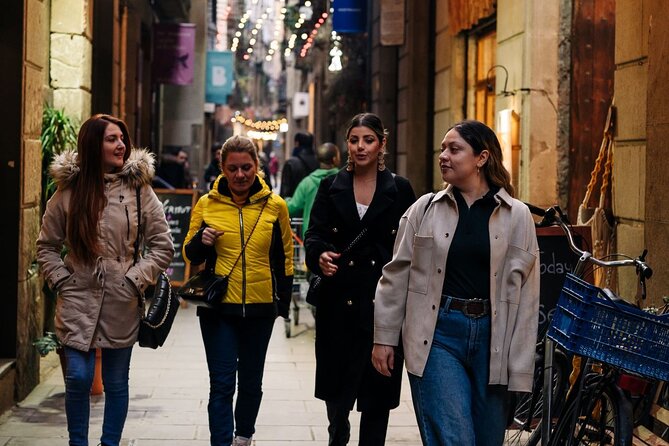
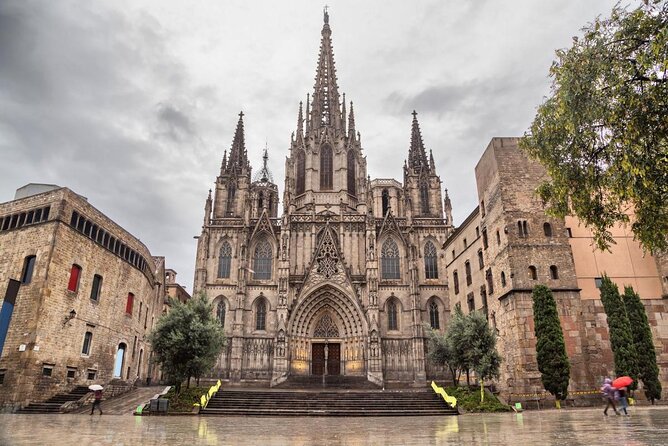
Barcelona Cathedral is one of the route’s major religious and architectural stops. Its Gothic form developed over centuries, so the building is best understood as a long project rather than a single burst of construction.
The guide explains the life and death of Eulalia, Barcelona’s patron saint. Her brutal martyrdom is central to the cathedral’s story and gives the building a human focus. You are not just looking at stone vaults and Gothic decoration. You are hearing why this church matters to the city.
Admission is not included, so check the arrangements when booking if entering the cathedral is important to you. The tour allots about 10 minutes, which suggests a short exterior explanation or a brief look rather than a full architectural visit.
I would treat this as an introduction. If you want time for the interior, chapels, cloister, or detailed art, plan a separate visit.
More location walks in Barcelona:
- Marvels of Barcelona Walking Tour
★ 4.9 · 53 reviews - Barcelona Marvels: A Guided Walking Tour of the City’s Highlights
★ 5.0 · 43 reviews - Barcelona: Marvels of Barcelona Walking Tour
★ 4.9 · 36 reviews - Magical London: Harry Potter Guided Walking Tour
★ 4.7 · 22,044 reviews
Roman Barcelona at Casa de l’Ardiaca
Casa de l’Ardiaca is small, but it gives the tour a useful change of scale. This building combines Gothic and Renaissance features and includes remains connected with Roman Barcino.
The old wall and aqueduct arcades show how far back the city’s story reaches. You can stand in a narrow Gothic Quarter setting and still see evidence of the Roman settlement beneath it.
The stop lasts about 10 minutes and is free. It is especially useful if you enjoy archaeology, since the guide can point out traces that do not announce themselves like a major monument.
One guide, Sonia, was praised for approaching the route from an archaeological angle. If your guide has a similar interest, this may be one of the most rewarding pauses for you.
Pont del Bisbe and a Gothic Quarter legend
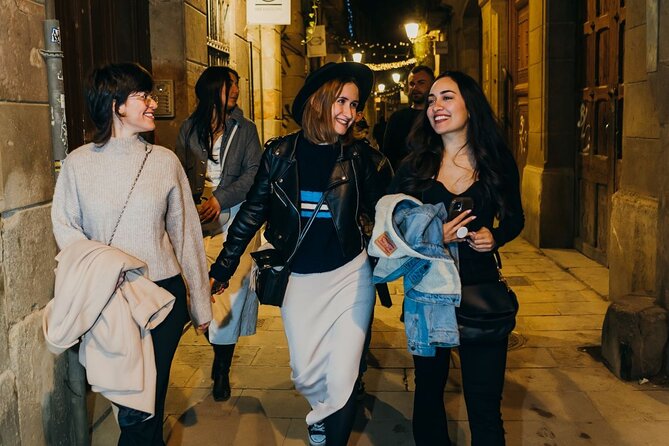
Pont del Bisbe, or Bishop’s Bridge, is one of the old quarter’s most photographed views. Its stone arch connects historic buildings above the narrow street and makes a memorable picture.
The guide also shares the legend associated with the bridge. The story is meant to catch both superstitious and skeptical listeners, especially anyone wondering what might happen when walking beneath it.
You spend about 10 minutes here. The value is less in the structure’s size than in the way a local story changes your attention. On your own, you might photograph the bridge and move on. With context, you start looking at the surrounding façades and the old quarter as a place layered with rumor and memory.
Expect other people in the area. This is not a quiet private corner, even if the story feels personal.
Plaça Sant Felip Neri carries the heaviest mood
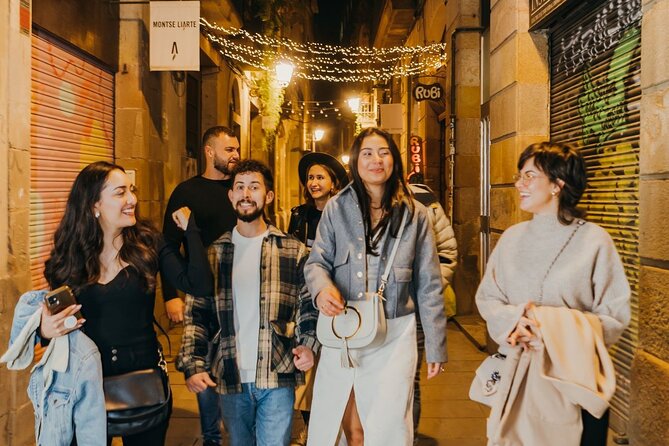
Plaça Sant Felip Neri is a small square with a serious past. Its scars and history are tied to the conflict surrounding Catalan independence, and the stop shifts the tone from architecture to loss.
This is not a quick cheerful photo stop. The guide explains the tragedy connected with the square and the political feeling that still surrounds it. You may find the setting more affecting because it is tucked away from the larger routes and easy to pass without understanding.
The planned visit is about 10 minutes. That is enough for the central story, though the square deserves a quiet look before the group moves on.
I like having this stop in the route because it keeps the tour from turning Barcelona into a parade of pretty façades. The city’s past includes violence, political pressure, and grief, and the walk makes room for that.
El Call recalls Barcelona’s Jewish community
MUHBA El Call takes you into the former Jewish quarter, known for narrow streets and medieval buildings. This part of the old city helps fill in a piece of Barcelona’s past that can be easy to overlook.
The route does not present the Gothic Quarter as a single Christian or royal story. It also points to the Jewish community that once lived and worked here. The tight streets make the area feel different from the wider plazas nearby, and the guide’s explanation helps you read the street plan as more than a pretty backdrop.
Again, you have around 10 minutes. That makes this a first introduction rather than a full study of the district. If Jewish history is a major interest, note the location so you can return with more time.
Plaça de Sant Jaume puts politics in the open
Plaça de Sant Jaume is Barcelona’s main civic square. It houses the Catalan government and City Hall, and it has long been a place for celebrations, demonstrations, and public statements.
This is where the walk’s political thread becomes especially clear. The guide discusses an important figure honored during one of the city’s beloved holidays, while the square itself shows how history remains part of daily civic life.
You spend about 10 minutes here. The open space makes it easier to understand the city’s political center, though it can also be noisy and busy. Keep close to the guide if the group is large.
I find this stop useful because it gives context to the independence story mentioned earlier. Political identity here is not locked in a museum. It appears in the places where people gather.
Plaça del Rei and the Royal Palace
Plaça del Rei has a more formal mood. The Royal Palace gives the square a sense of power, while the guide connects the area with the Spanish Inquisition.
That pairing matters. The setting may look grand and controlled, but its past includes fear, investigation, and religious persecution. A short explanation can help you see the square as a place shaped by authority rather than simply admire its architecture.
The tour allows about 10 minutes, and there is no separate admission charge listed for this stop. You should not expect a full palace visit during the walk. Think of it as an exterior historical orientation.
This is another stop where the route earns its price by connecting buildings with events. Without the story, the square might be just another attractive Gothic scene.
Plaça de l’Àngel links trade with legend
Plaça de l’Àngel was once known as Wheat Square because grain trading took place there. Its later name, Angel’s Square, comes from a heavenly apparition said to have appeared during a procession carrying Saint Eulalia’s body.
The stop joins practical city life with religious tradition. Trade, transport, ceremony, and belief all meet in one place.
You spend about 10 minutes here, and the story gives you a handy way to remember the square. It also brings Saint Eulalia back into the route after the cathedral stop, tying separate parts of the walk together.
Santa Maria del Mar is a fitting finish
The walk ends at Basílica de Santa Maria del Mar in El Born. This Gothic basilica is one of Barcelona’s best-known churches and reflects the city’s connection with the sea and maritime trade.
After the narrow streets and political squares, the basilica gives the route a strong final landmark. Its setting in El Born also shows how the old city changes as you move east from the Gothic Quarter.
Admission is not included. The tour spends about 10 minutes here, so you will get an introduction rather than a full visit. If the basilica interests you, note the end point and return later when you can take your time.
Ending here is practical too. You finish in El Born, an area that can easily support more exploring after the guide leaves. Several people found the route useful for picking up local ideas, including a tapas recommendation from Sonia. That kind of advice can add value well beyond the two-hour walk.
What the guides add to the experience
The guide makes or breaks a compact history walk. This route has been led by people such as Darren, Petra, Jorge, Sonia, Sonja, Lydia, Sarah, Vanessa, Rolene, and Mariah.
Darren was noted for clear English, enthusiasm, and useful recommendations. Petra brought strong insight into the Gothic Quarter and El Born, while Jorge focused on hidden corners and practical local tips. Sonia combined archaeology with good food advice, and Vanessa handled questions across art, religion, politics, and city history.
The feedback is not perfectly uniform. One person felt that the content could have been stronger on a first-time tour led by Rolene, though another found her able to make a lot of history fun in two hours. That is a fair reminder that guides vary, and that the tour’s quality depends partly on who leads your departure.
The common strength is the human explanation. You are not given only dates and names. You get stories, connections, and suggestions for what to do next.
Price, pace, and group size
At $22.99 per person, this is a reasonable buy for a first orientation to central Barcelona. Eleven stops, an English-speaking local guide, and a route through two major old-city districts give you plenty of material for the money.
The value is strongest if you are new to Barcelona and want to decide where to return. It is weaker if you already know the Gothic Quarter well or want long interior visits. The tour moves quickly, with about 10 minutes assigned to each stop, and walking time must fit between them.
Groups can reach 20 people. That is still manageable, but it is not the same as a private conversation. A private upgrade makes sense if you have a strong interest in archaeology, Catalan politics, religious art, or architecture and want more time for questions.
Wear good walking shoes and use sun protection. That practical advice came up for a reason. The route is on foot, and the streets can expose you to sun and city noise.
The tour is offered in English, uses a mobile ticket, is near public transportation, and most people can participate. You receive confirmation at booking. Free cancellation is available up to 24 hours before the start time, while later cancellations and changes are not accepted.
Who should book this Barcelona walk?
Book it if you want a clear first map of the old city and prefer stories to a simple photo checklist. It suits first-time visitors, short-stay visitors, and anyone who wants help spotting Roman traces, Jewish history, Catalan politics, and artistic connections.
It also works well on your first day. Jorge’s local suggestions and the food advice associated with Sonia show how the route can help you choose what to see and eat afterward.
Think twice if you dislike group walking, need long stops, or want detailed church interiors. The cathedral and Santa Maria del Mar both require extra time if you want to explore inside, and neither admission is included.
For $22.99, I would book this as an orientation rather than a complete Barcelona history lesson. Stay close to the guide, ask questions, note the places you want to revisit, and treat the final basilica as the start of your El Born exploring, not the end of your day.
FAQ
How long does the Barcelona walking tour last?
The tour lasts approximately two hours.
Where does the tour begin?
It begins at Plaça del Vuit de Març in Ciutat Vella, Barcelona.
Where does the tour end?
The walk ends at Basílica de Santa Maria del Mar, Plaça de Santa Maria, 1, in Ciutat Vella.
Is the tour offered in English?
Yes. The experience is offered in English.
What is the price?
The listed price is $22.99 per person. Group discounts are available, and you can also upgrade to a private tour.
Are cathedral and basilica admission tickets included?
No. Admission is not included for Barcelona Cathedral or Basílica de Santa Maria del Mar. The other listed stops have no admission charge.
How large is the group?
The tour can include a maximum of 20 people. It is also near public transportation, and most people can participate.
More 2-Hour Experiences in Barcelona
- Rome: 2-Hour Gladiator School
★ 4.7 · 630 reviews - 2-Hour Hollywood Bus Tour
★ 4.5 · 461 reviews - James Bond Shooting Locations 2-Hour Walking Tour of London
★ 4.7 · 332 reviews - 2-Hour Hollywood, West Hollywood and Beverly Hills Open Bus Tour
★ 4.5 · 290 reviews
Just added around Barcelona
- Paint & Wine Workshop in an Art Studio in Barcelona★ 5.0 · 25 reviews
- Shine in the Streets of Barcelona: cinematic & candid photos★ 5.0 · 3 reviews
- 20-min Barceloneta & The Beach Supercar City Tour★ 4.5 · 16 reviews
- Marvellous Montserrat Private Day Tour : Train & Cable-car tickets Included★ 4.5 · 2 reviews
- Game of Thrones: Medieval Girona Private Tour with Hotel pick-up★ 5.0 · 15 reviews
- Barcelona: Professional Photoshoot by the Beach★ 5.0 · 2 reviews
- Exclusive Gaudi Segway Guided Tour Architectural Marvels★ 5.0 · 2 reviews
- 6 hours private tour of Girona: GAME OF THRONES from Barcelona with pick up★ 5.0 · 5 reviews
Barcelona Film Location Tours, compared.

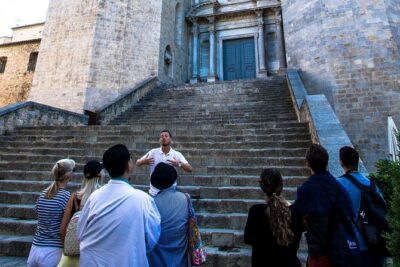
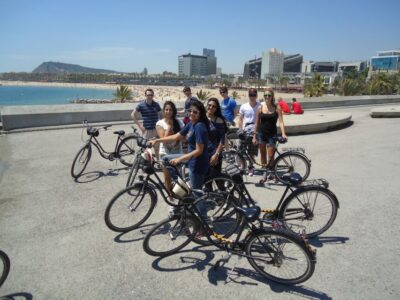
Barcelona Highlights Bike Tour: Cycle along the beach!
Read our review →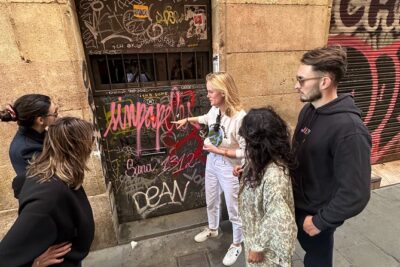
Barcelona Street Art Tour with Exclusive Artist Studios Visit
Read our review →
Barcelona Photo Experience: famous landmarks or the beach!
Read our review →
Barcelona Marvels: A Guided Walking Tour of the City’s Highlights
Read our review →Browse the lists this tour appears in