
REVIEW · NEW YORK CITY
Central Park Pedicab Tours – History and Movie Locations
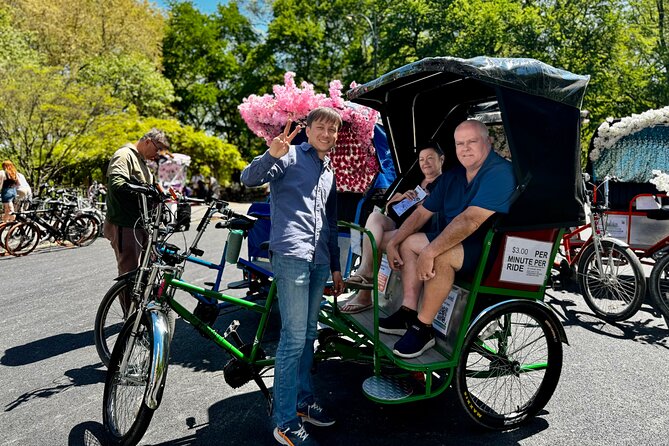
Central Park is too large to understand in a quick walk, but a pedicab gives you a practical shortcut through its best-known sights. You can see Bethesda Terrace, Bow Bridge, Strawberry Fields, the Mall, and film locations from Home Alone 2, The Fisher King, Stuart Little, and Rosemary’s Baby without wearing out your feet. The guide handles the cycling while you watch the park unfold.
I like the private format, since your group can focus on the places and stories that matter most to you. I also like the mix of movie lore and park history, from Balto’s heroic statue to the restored Minton tiles beneath Bethesda Terrace. The main consideration is time: a one-hour ride can cover the major sights, but the longer route is a better choice if you want the northern park, Belvedere Castle, and the Metropolitan Museum of Art area.
Key points to know before you book
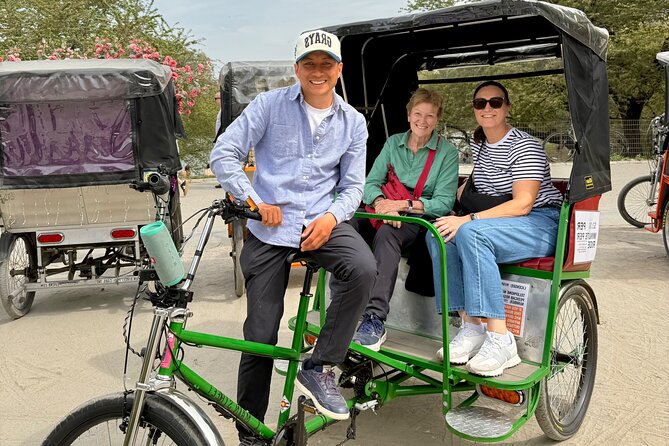
- Private pedicab ride: Only your group takes part, so the pace and conversation are more personal than on a large sightseeing tour.
- Famous movie settings: See places linked with Home Alone 2, The Fisher King, Stuart Little, Sex and the City, 27 Dresses, Ghostbusters, and Rosemary’s Baby.
- Flexible duration: Routes run about one to three hours, with the Alice in Wonderland statue, Cleopatra’s Needle, the Met, the Reservoir, and Belvedere Castle included on the two-hour route.
- Feet-saving sightseeing: You can cover a lot of ground while the guide pedals and points out details you could easily miss on your own.
- Strong guide service: Ricky is specifically praised for his friendly manner, clear stories, and ability to point out both movie spots and lesser-known details.
- Good value for small groups: At $38.40 per person, the price is most attractive when you want a private introduction to the park without paying for several separate activities.
Why a pedicab works so well in Central Park
Central Park covers more than 800 acres, and its winding paths can make a first visit feel less simple than the map suggests. The park was designed by Frederick Law Olmsted and Calvert Vaux in the 1850s as a green retreat from Manhattan’s fast-growing city, with lakes, bridges, open lawns, wooded paths, and carefully placed buildings.
A pedicab lets you move between these areas without spending your entire visit walking from one end to another. You can pause for photographs at major sights, hear the story behind a statue or bridge, and keep moving before the park’s size becomes tiring.
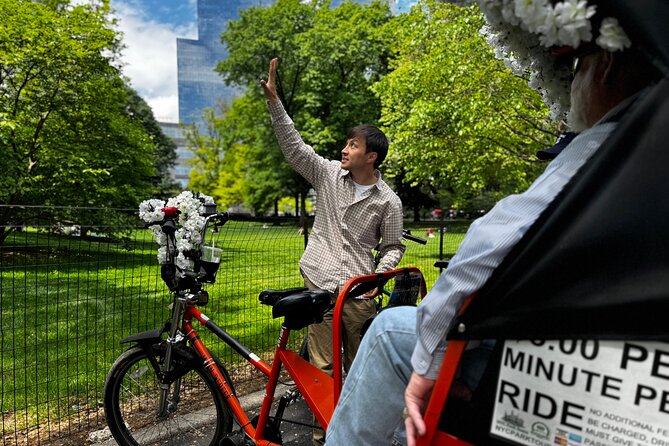
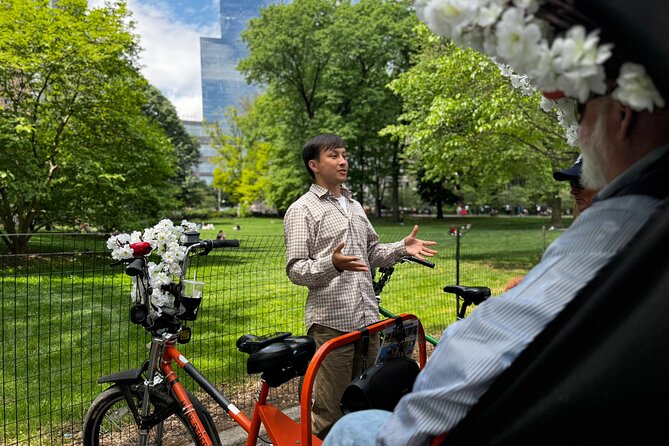
The private setup matters. You are not joining a large group that has to follow a fixed script. Your guide can explain the film connection at the Pond, point out the best angle at Gapstow Bridge, or give more time to a favorite spot. Ricky is the guide named in the experience information, and the strongest praise centers on his friendly approach and the way he mixes useful facts with movie locations.
There is one practical limit. A pedicab is a sightseeing vehicle, not a full replacement for walking. At several places, you will want to get out for photographs or a closer look. The ride helps you cover distance, but the best parts still reward a few minutes on foot.
More history behind the scenes in New York City:
- Game of Thrones & History of Dubrovnik Tour
★ 5.0 · 628 reviews - History and Movie Tour of Beaufort by Golf Cart
★ 5.0 · 562 reviews - Memphis: Big Mojo Sun Studio + Music History 3-Hour Bus Tour
★ 4.8 · 325 reviews
The southern park: Gapstow Bridge, Wollman Rink, and movie scenes
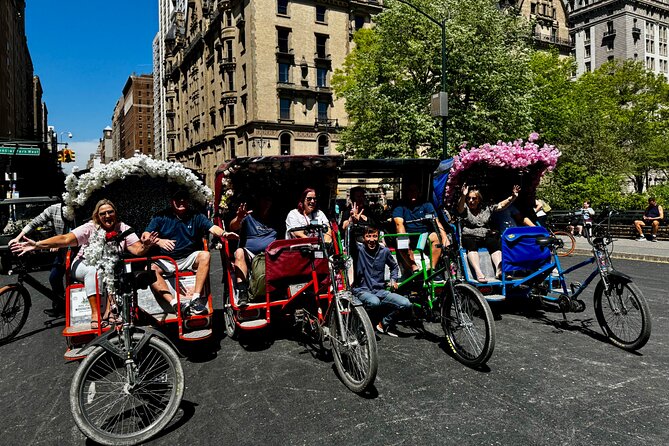
The route may begin around the southern end of Central Park, where the city rises around the trees and open paths. Wollman Rink is one of the first notable stops. It opened in 1950 and remains a familiar winter scene, with skating against a backdrop of Manhattan buildings. The listed stop is brief and admission is free, so think of it as a photo pause rather than a rink visit.
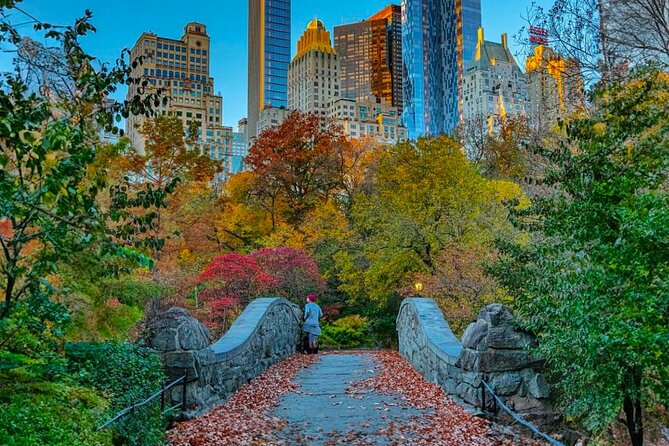
Nearby, Gapstow Bridge gives you one of the park’s most recognizable views. The stone bridge replaced an earlier wood and cast-iron structure and now frames The Pond, nearby trees, and the Plaza Hotel. It is a small stop, but the view explains why filmmakers and photographers return to it.
The Pond is linked with one of the most memorable moments in Home Alone 2: Lost in New York, involving Kevin and the pigeon lady. The waterway began with natural rock and a brook, then became part of the carefully planned park setting. I like this stop because it shows how Central Park can feel quiet and almost rural while high-rise Manhattan sits close by.
The Central Park Zoo is another southern highlight. It began as an informal collection of donated animals in the 1860s and later shifted toward more natural habitats. You will see the zoo from the outside during this sightseeing ride, not tour its exhibits, so the value here is the story and location rather than an animal visit.
The Balto statue adds a different kind of story. Balto led the final section of the 1925 sled-dog run that carried diphtheria medicine to Nome, Alaska. The bronze statue was unveiled in 1925 and honors the dogs that made the dangerous delivery possible. It is a quick stop with a strong human detail: New Yorkers raised money to honor the dog soon after the mission.
The Mall and Bethesda Terrace, Central Park’s grandest sequence
The Mall is one of the easiest places to recognize in photographs. It is a straight, tree-lined promenade in a park otherwise designed around winding routes. The path was meant for leisurely walks and carriage rides, and its statues of writers explain the name Literary Walk.
You may see statues of William Shakespeare, Robert Burns, and Sir Walter Scott, along with the Christopher Columbus monument at the southern end. The American elm canopy is especially striking when the trees are full, though the experience depends on the season.
The ride then reaches Bethesda Fountain and Bethesda Terrace, the central showpiece of the park. The fountain’s Angel of the Waters was designed by Emma Stebbins and unveiled in 1873. Its theme comes from the biblical Pool of Bethesda, where an angel was believed to bring healing to the water.
The fountain has appeared in Home Alone 2, Enchanted, The Avengers, and Elf. Those film connections make the stop fun for movie fans, but the architecture is the real reason to linger. Bethesda Terrace opens toward The Lake, giving you a carefully framed view from the upper level down to the fountain and water.
Look up beneath the terrace arcade. The ceiling is covered with Minton encaustic tiles made in England and installed in the 1860s. The tiles were removed during a later renovation, then restored and returned in 2007 after a major conservation project. This is one of the details I would not want to miss on a quick independent visit.
Nearby Cherry Hill Fountain was once a watering trough for horses. Its granite dome, bluestone basin, tile work, and glass lamps show how even practical parts of the original park were given serious design attention. The stop is short, but it helps you see that Central Park was planned as a complete experience, not simply planted with trees.
The Lake and Bow Bridge, where the scenery becomes cinematic
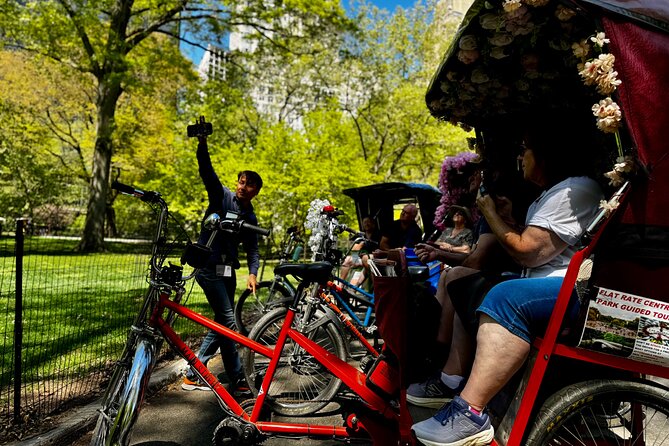
The Lake is the park’s visual center, linking Bethesda Terrace with the Ramble and several shaded paths. It covers about 20 acres and is one of the places where the park’s formal design gives way to quieter water views.
The nearby Boathouse has connections with Sex and the City and 27 Dresses. The original Victorian building was designed by Calvert Vaux in the nineteenth century, but the present building dates from 1956 after the earlier structure burned. It now offers dining and heated outdoor seating, although the pedicab tour does not include a meal.
Bow Bridge is one of the tour’s most photogenic stops. Completed in 1862, this graceful cast-iron bridge curves over the Lake and is often associated with romantic films and city montages. Its screen appearances include Manhattan, The Way We Were, Spider-Man 3, Night at the Museum, Autumn in New York, Great Expectations, and Glee.
The bridge is also a useful example of why a guide helps. You get the film references, the names of the designers, and the practical chance to stop for a photograph without trying to locate the bridge yourself. The bridge has undergone restoration, including work in 2023, so its delicate details remain part of the experience.
Other nearby points may include the Falconer statue, the Daniel Webster Monument, and Pinebank Arch. The Falconer shows a figure releasing a falcon, while the Webster monument honors the statesman and orator. Pinebank Arch is quieter, with cast-iron work designed to fit into the rock and foliage around it. These are the sort of details that can disappear if you only follow the most famous postcard stops.
A few more filming locations around New York City worth a look
- NYC TV & Movie Locations Bus Tour – Friends, Seinfeld & More
★ 4.5 · 1,270 reviews - NYC: Central Park Celebrity Homes & Film Spots Pedicab Tour
★ 4.9 · 817 reviews - NYC: Harry Potter and the Cursed Child on Broadway
700 reviews - Central Park TV and Movie Sites Walking Tour
★ 4.5 · 499 reviews
Strawberry Fields, the Dakota, and the park’s western side
Strawberry Fields is a peaceful memorial to John Lennon, created after his death in 1980. At its center is the Imagine mosaic, donated by the city of Naples. Visitors often leave flowers, play music, or pause quietly, so this stop calls for a little more respect and less rushing than a normal photo point.
The nearby Dakota apartment building adds a strong film and music connection. John Lennon and Yoko Ono lived there, and Lennon was killed outside the building in 1980. Its exterior was used in Rosemary’s Baby, where the building’s Gothic character helped create the film’s unsettling mood.
Sheep Meadow offers a sharp contrast. It is a broad 15-acre lawn with views toward Manhattan and room for relaxing, reading, picnicking, or simply watching the city from the grass. Its name recalls the sheep once kept in the park, and the nearby Tavern on the Green building originally served as their sheepfold.
The meadow has appeared in Ghostbusters, Wall Street, and The Fisher King. Tavern on the Green later became a restaurant, closed for a period, and reopened after renovation. The tour does not include food, but the building helps explain how Central Park has changed from a designed public retreat into a setting used for dining, concerts, films, and daily city life.
Heckscher Playground may also be included on the longer route. Opened in 1926, it is the oldest and largest of Central Park’s 22 playgrounds. This stop will matter most to families or anyone interested in how the park serves local residents, not just sightseeing crowds.
The two-hour route: Alice, Cleopatra’s Needle, and Belvedere Castle
The two-hour option adds several of the park’s best-known northern and central sights. At the Alice in Wonderland statue, children can climb and touch the bronze figures of Alice, the Mad Hatter, the Cheshire Cat, and the White Rabbit. George Delacorte donated it in 1959 as a gift to New York’s children and as a memorial to his wife, Margarita.
This is one of the easiest stops for families to enjoy because it is made for interaction rather than quiet admiration. It can also be busy, so a short visit may be enough for photographs.
Cleopatra’s Needle offers a very different experience. The ancient obelisk is more than 3,500 years old, was carved in Egypt during the reign of Thutmose III, and arrived in Central Park in 1881. Its hieroglyphs connect Manhattan with ancient Egypt in a way few city tours can match.
The route can also include the Metropolitan Museum of Art, founded in 1870. The original building along Central Park’s eastern edge was designed by Calvert Vaux, and the museum now holds more than two million works covering 5,000 years of human history. The pedicab stop is an exterior introduction, not admission to the museum, so plan a separate visit if you want to go inside.
The Jacqueline Kennedy Onassis Reservoir is another longer-route stop. Built between 1858 and 1862, it covers 106 acres and once ranked as the world’s largest man-made water body. Its broad water surface and curved edge feel very different from the smaller Pond and Lake.
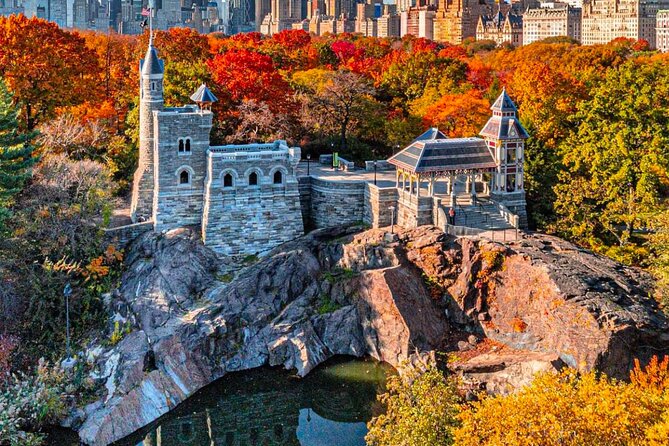
Belvedere Castle is the grand finish for many visitors. Designed in 1867 by Vaux and Jacob Wrey Mould, it was built as a decorative folly on Vista Rock. The name means beautiful view, and the observation deck looks toward Turtle Pond, the Great Lawn, and the Ramble.
The castle also houses Central Park’s weather station, which has operated there since 1919. Admission is included, but the timing still matters. If you want a slower look from the observation deck, the two-hour route gives you a better chance than the one-hour option.
Price, timing, and who gets the best value
The price is $38.40 per person, including the pedicab and all fees and taxes. For a private ride through a large park, that is fair value if you want a guided overview rather than a self-planned walk. The price becomes more appealing for a group that would otherwise pay for several separate sightseeing activities or spend much of the day finding the main sights.
The duration is listed at about one to three hours. The shorter ride suits you if Central Park is one part of a packed New York day. The two-hour route is the sensible middle choice for most first-time visitors because it adds Alice in Wonderland, Cleopatra’s Needle, the Met area, the Reservoir, and Belvedere Castle.
A three-hour visit is better for a slower pace and more photo stops. I would choose it if you care about both films and design details, since the park has too many landmarks to appreciate when every stop is rushed.
The meeting point is at 1415 6th Avenue, and the ride returns there. Hotel pickup and drop-off are not included. You receive a mobile ticket, and the experience is offered in English.
The tour needs good weather, and cancellation is free up to 24 hours before the start time. If poor weather cancels the ride, you can receive another date or a full refund. The same applies if the minimum number of participants is not met.
Should you book this Central Park pedicab tour?
Book it if you want a private, efficient introduction to Central Park and like the idea of connecting film scenes with real places. It is especially useful for families, older visitors, couples, and anyone who wants the stories without a long cross-park walk.
Choose the longer route if this is your main Central Park visit. The one-hour option covers the signature sights, but two hours gives the experience more shape and includes the castle, Reservoir, Alice statue, Cleopatra’s Needle, and Met area.
Skip it if you want a quiet day of unstructured walking, rowing, or museum time. The pedicab gives you access and context, but it cannot replace lingering beside The Lake or spending hours inside the Met. For most visitors with limited time, though, the private ride offers a smart way to see the park’s famous corners, hear their stories, and leave with your feet still ready for the rest of Manhattan.
FAQ
How much does the Central Park pedicab tour cost?
The price is $38.40 per person. All fees and taxes, along with the pedicab, are included.
How long does the tour last?
The experience lasts approximately one to three hours. The Alice in Wonderland statue and several northern Central Park stops are included on the two-hour route.
Is the tour private?
Yes. Only your group participates in the activity.
Where does the tour begin?
The meeting point is 1415 6th Avenue, New York, NY 10019.
Where does the tour end?
The activity ends back at the meeting point.
Is hotel pickup included?
No. Hotel pickup and drop-off are not included.
What language is the tour offered in?
The tour is offered in English.
Are tickets included?
Admission tickets are included for the stops where an admission ticket is listed. The pedicab and all fees and taxes are also included.
Can I cancel for a full refund?
Yes. You can cancel at least 24 hours before the start time for a full refund. Cancellations within 24 hours are not refunded.
What happens if the weather is poor?
The experience requires good weather. If it is canceled because of poor weather, you will be offered another date or a full refund.
Just added around New York City
- New York City Superheroes Tour Marvel and DC Comics Origins★ 4.5 · 27 reviews
- Tour of Dr. Laser’s Holographic Studios and Laser Lab★ 4.5 · 3 reviews
- The Story of Grand Central Terminal: An Art And Engineering Marvel★ 5.0 · 10 reviews
- Stranger Things: The First Shadow on Broadway Ticket★ 4.5 · 3 reviews
- SUCCESSION Walking Tour of Uptown Manhattan Filming Locations★ 5.0 · 2 reviews
- Self Guided “Central Park Movie Tour” Solo Walking Tour in New York City★ 4.5 · 2 reviews
- Private Sex and The City Tour in New York with Movie Scenes from famous TV show★ 4.0 · 23 reviews
- Private Marvelous Mrs. Maisel Sites Guided Tour★ 5.0 · 4 reviews
New York City Film Location Tours, compared.

NYC TV & Movie Locations Bus Tour – Friends, Seinfeld & More
Read our review →
NYC: Sex and the City Hotspots Bus Tour (On Location Tours)
Read our review →
NYC: Central Park Celebrity Homes & Film Spots Pedicab Tour
Read our review →
NYC The Sopranos Iconic Filming Locations Bus Tour
Read our review →NYC The Sopranos Iconic Filming Locations Bus Tour
Read our review →Browse the lists this tour appears in